
Utilizing the Power of Storytelling at Your Next Event

Skift Take
Storytelling runs as an undercurrent of many cultures. If you’re not telling the story of your event, you’re missing an important opportunity for connection.
Okay, let’s be honest. There is no measurable way to prove the claim of mystical storytelling power when it comes to events but chances are that word made you click on this article. It sounds interesting, beguiling, alluring. It begs to be read and calls to you like distant land you can only access through an oversized piece of furniture.
Did you see what I just did?
I began painting a picture that probably ended with you thinking about a truly amazing story, the Lion, the Witch and the Wardrobe. Either that, or you never had a childhood.
But what exactly can storytelling do for your event? Quite simply it can:
- Transform an ordinary event into an extraordinary happening.
- Make attendees feel connected to the host organization.
- Help guests escape into a world of their choosing.
- Define your brand mission or culture.
- Inspire action.
Honestly, I could go on. Stories have been used for millions of years for everything from entertainment to trying to get out of trouble. They teach small children difficult concepts and they unite disjointed groups. But storytelling is only starting to make its way to events in a formal sense and here’s why that’s a really good thing.
Explore the Skift Meetings Toolkit
Level up your skills in minutes and start streamlining the way you plan meetings and events.
Hundreds of articles in nine key categories: Accessibility & Inclusion | Budgeting & Cost Savings | Careers & Personal Development | Contracts & Duty of Care | Event Technology | Ideas & Inspiration | Logistics & Operations | Marketing & Promotions | On The Road
What is Storytelling and Why Is It Important?
Storytelling in events is communicating something about you and what you identify (or disassociate) with. It allows people to feel in addition to think. It can be done visually, orally, or through written communication. The best event storytelling is woven throughout the entire event. A story should never live only on your about page or your opening presentation or message. It should resonate throughout.
Your story is the essence of your organization/event.
Storytelling is essential because it’s an easy way to:
- Entertain
- Inspire
- Educate
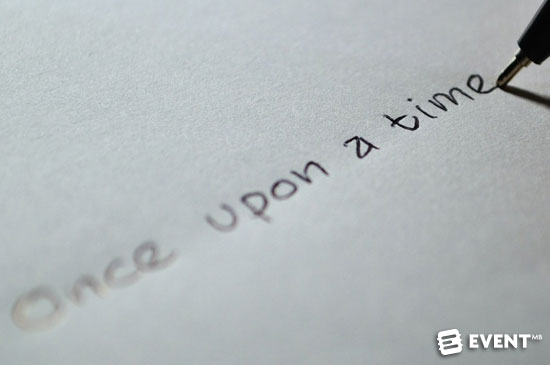
The broad phrase of storytelling encompasses a lot. At its most basic, it’s a literal story, a once upon a time moment. But in a more general sense, it can also be the lifeblood of your event. For instance, you can tell the story of how your event came to be. Your presenters can use story to educate. An attendee can share their story of why this event is so extraordinary, while you can also create an event that is a magical escape in an all-encompassing story like Dragoncon, which we’ll get to later. You can sell with story or increase loyalty and engagement.
But story can also be done simply by the language you use in your communications. People tend to skip over bland statements and cliches. Sprinkle your event communications with linguistic glitter. Make your pieces fun to absorb.
Brands have found storytelling to be so important in converting sales that enterprises like Nike keep a staff of brand storytellers on board. But storytelling is more than just a way to improve marketing. It triggers empathy and understanding.
According to Jeremy Hsu’s research, as published in Scientific American, it’s also the way we currently communicate. He found:
“Personal stories and gossip make up 65% of our conversations”
For those of us who love math, that’s over half. Half of our daily conversation is story-driven. No wonder people recognize and connect with it. Plus, have you even seen someone walk out of the room during a good story?
Why You Should Be Using Stories in Your Events
In addition to the possibilities mentioned earlier about what stories can do, stories are memorable. When we experience a story multiple areas of our brains respond. Leo Widrich wrote in the article, The Science of Storytelling: What Listening to a Story Does to Our Brains:
“When we listen to a standard presentation, our language processing regions in the brain, Broca’s area and Wernicke’s area are active. When we are being told a story though, not only are the language processing parts in our brain activated, but other areas in our brain, the ones we would use when experiencing the events of the story are stimulated as well.”
The brain doesn’t differentiate between experience and a good story so when you incorporate storytelling into your event you’re increasing the impression you make on your attendees and this activates referral and word of mouth marketing.
How Do You Tell Good Stories?
While there are many “goods” our cultures can agree on, when it comes to a good event story it must contain:
- At least one point your audience can identify with. Going into a third world country, for instance, and telling a story about a first-world dilemma like a crack in a cell phone screen won’t move many in that audience. You need something that will resonate with them. It can be something they’ve experienced or something they can imagine but it has to evoke a response. Remember, a story is a collaborative effort between you and the audience.
- Struggle. Without friction, it’s not a story. Tension is what keeps people involved. You need for them to wonder what’s next or what will happen. That “caring” is part of what makes the impression.
- A hero. This can be a single person or a group. The most effective stories will cast your attendees, or former attendees, as hero. You want your audience to see themselves in that role because you want them to cast you in the role of the person/organization that helped them achieve their success. They should be the hero. You can be the sage Gandalf or Obi Wan.
- A discernable ending or outcome. This isn’t an art school film. You need to provide your audience with an actual or foreseeable ending and it should be one that is bathed in optimism.
- A call to action. This is the difference between being an event planner and being a novelist. A writer needn’t worry about a call to action in a good story because the only call to action that matters is buying the book, or perhaps telling someone else about it. Preferably, Oprah. Anyone using storytelling for business had better be prepared to channel their audience’s emotional response into something. Don’t get them all worked up and inspired and let that opportunity pass.
A final point to good event storytelling: Your story should not be a work of fiction. If it doesn’t align with your organization, it will not have the engaging, loyalty-building result you’re looking for.