
Women Leaders in Meetings: Cassandra Farrington

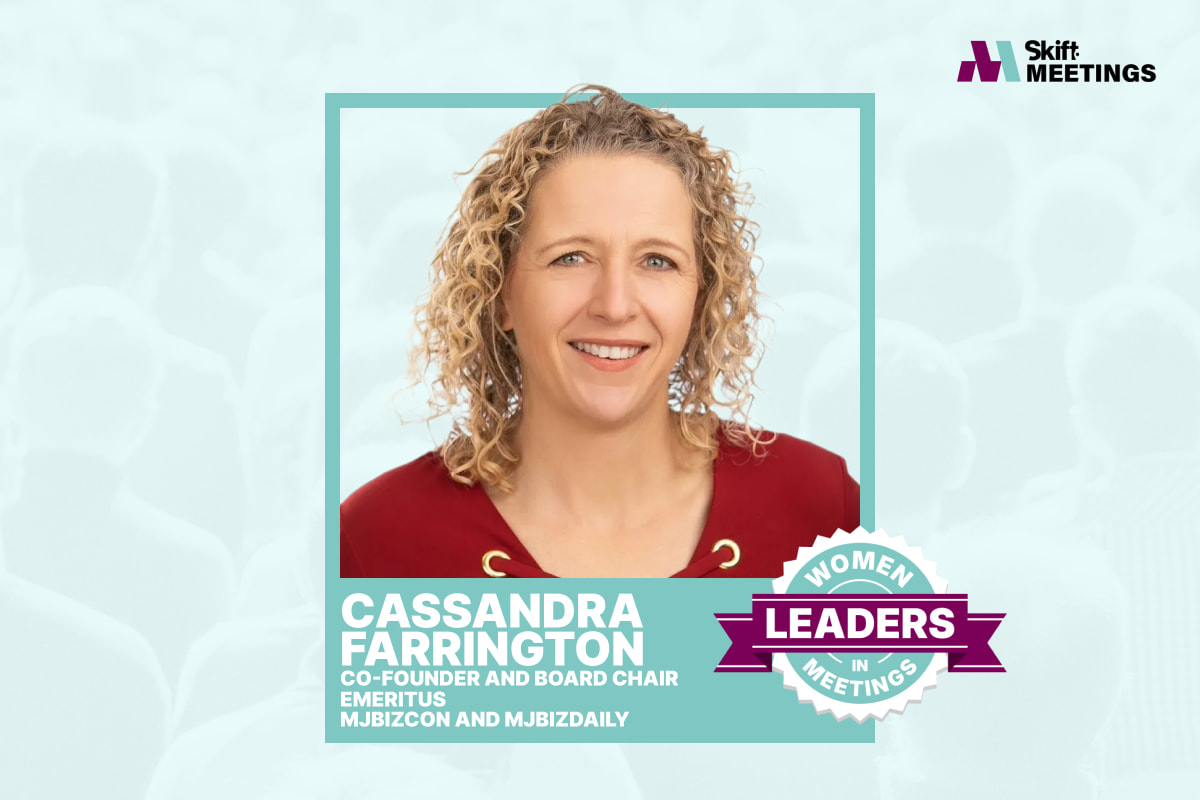
Photo Credit: Cassandra Farrington
Skift Take
Cassandra Farrington didn’t just build a media brand, she helped professionalize an industry long dismissed as fringe. By turning MJBizCon into the must-attend event for cannabis professionals, she proved that credibility, scale, and community could grow even in the most uncharted business terrain.

When Cassandra Farrington co-founded Marijuana Business Daily (MJBizDaily), she wasn’t just launching a media brand, she was staking a claim in a business that was far from mainstream.
Farrington transformed MJBizCon into one of the country’s fastest-growing trade shows, ultimately leading to a $120 million acquisition by Emerald.
Under her leadership, MJBizDaily made the Inc. 5000 list for five consecutive years and was named one of the top ten fastest-growing women-owned businesses by the Women Presidents Organization.
Farrington’s path began in finance and publishing, with strategic roles at Citigroup and experience in marketing — skills that would later fuel her entrepreneurial leap into cannabis media and events.
Cassandra Farrington will be a featured speaker at the Skift Meetings Forum on September 15 in New York City.
How did you land in the world of meeting planning?
I came to meeting and events planning originally as a revenue extension from B2B publishing. Since discovering live events, I’ve consistently been struck by the symbiotic relationship between well-produced B2B content and an associated live event. Great content that is well dispersed among your audience gives your event significant legitimacy. The event builds a community that is supported and enhanced year-round by the content. Combine that with the reality that excellent content is the best marketing vehicle a show could want. It’s a win-win-win.
What are the qualities that make a good leader?
Great leadership requires a nuanced combination of empathy and determination. A good leader has to listen to and identify with the challenges that the team is facing, whether work-related or in their personal lives, and then work to create an environment where people can collectively thrive while feeling personally supported. Yet, that cannot mean ‘everyone gets what they want.’ The business goal has to remain at the forefront, even though not everyone is going to necessarily like the way that goal gets achieved.
Striking that balance of having a strong forward-facing momentum while smoothing out the rough patches where possible is a key leadership quality.
How would you define your leadership style?
To me, culture is everything. While a great culture will not by itself get the job done, without it, a company is dead in the water.
To that end, I always strive to create an environment where people like what they do, and they like who they do it with. Bring on people who personally identify in some way with the business, the industry, and the goal of the team. Make sure they have the skills and abilities to be successful in their roles. That combination of things will help them feel engaged and successful, and thus they like what they do, day in and day out.
Surround them with people who also like what they do, who feel supported by the people around them, people who are ready with praise, slow with blame, and quick to help fix it when things go awry. You don’t have to want to go to happy hour with your whole team every night; you do need to feel respected, supported, and synergistically complemented by those around you.
What skills have you developed that have helped you grow into the leader you are today?
I’ve developed more of a sense of work-wellness balance over the past few years. The pressures of leadership, and the pressures of balancing a fulfilling career with a fulfilling home life – those pressures are real, and it is all too easy to simply delay taking care of yourself.
Getting back to that balance is part of why I’ve taken the past couple of years largely to myself. And as I turn back into a career mindset, I am taking those lessons of the last several months with me.
I’ve also developed a much better sense of differentiating bad decisions from bad outcomes. Not everything is going to work out as expected or hoped. So long as you made the best decision you could given what you knew at the time, don’t over-stress about a bad outcome.
As a leader, what are the challenges that keep you up at night?
The challenges that keep me up at night are the ones where it feels like there is no good option, and particularly when that involves people. Lots to do and overworked? There are solutions for that. Unskilled in a particular area? There are solutions for that. Being short on cash flow and needing to choose between paying Critical Vendor X vs Critical Vendor Y? That’s tough. Is there no longer a good place in the organization for a dedicated and popular team member whose role has outgrown them? That’s really tough.
Which female leaders have inspired you the most?
The women who have inspired me most are the ones who have been closest to my orbit. I do find lots of inspiration in certain household names, of course, and yet the ones who actually have influenced my daily and monthly decisions, the ones who have inspired the course of my life – those are my friends, business mentors, my family members. And in some cases, those are people from whom I’ve learned how I don’t want to be.
How has mentoring helped you become the leader you are today?
It’s a truism that you learn something more deeply and understand it more thoroughly when you teach it to someone else. When you’re explaining a leadership tenant to someone, you more keenly identify with it yourself. When you’ve just helped someone talk through an ethical dilemma they face, it’s easier to spot the ones in your own life that you might not be thinking about deeply enough.
How has your leadership style changed throughout your career?
There were times in my earlier career where I was overly collaborative, overly conscious of what the team wanted. I’ve found a better balance through time of still listening and making sure key people feel included and ensuring they have buy-in, and also sticking to my guns when a decision that needs to be made is unpopular.
Can you share advice for aspiring women leaders in meetings?
I’ve always been a person who didn’t feel like I needed to chime in on every topic to make sure I was heard and part of the conversation. Rather, I save my breath for when I’m confident about my point, and for when it really matters. In this way, when I do speak up, my points come across more effectively and are more respected.
What does leadership mean to you?
Leadership is about doing the right thing consistently for the greatest number of people over the longest time horizon, whether they agree with you or not in the moment. From the foundation of ‘be a good person,’ make the best decision you can and move forward decisively.