
Events Under Pressure: How Planners Are Designing for Uncertainty

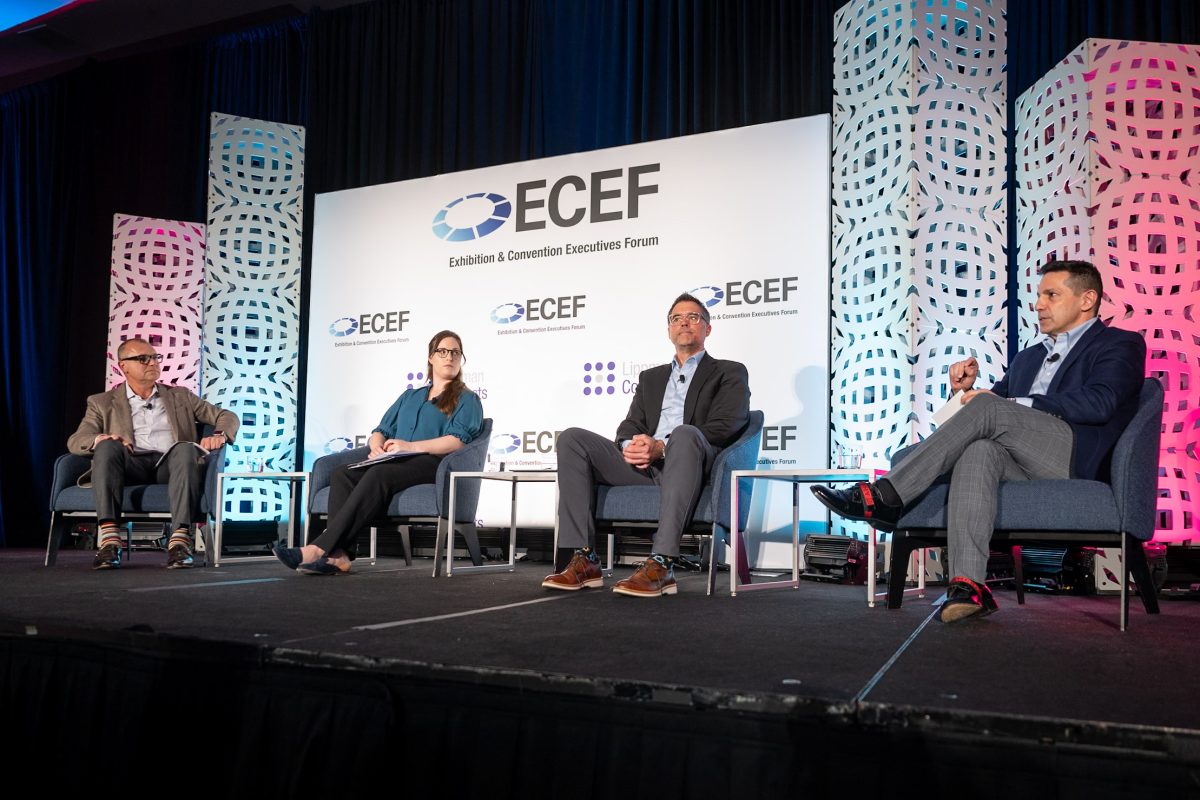
Photo Caption: Hervé Sedky, Isabelle Icso, Kevin Hinton, and Rich Scarfo during ECEF session on navigating headwinds. CHRIS FERENZI
Skift Take
ECEF 2025 underscored that the events industry is no longer reacting to disruption; it’s reengineering itself in response. Events are evolving to address this instability head-on.

Growing geopolitical instability, trade tensions, and unpredictable policy shifts are forcing event organizers to rethink everything from show formats to sponsorship models, according to leaders gathered at the Exhibition & Convention Executives Forum (ECEF) on May 28.
“This is a quasi-crisis for the world,” said Consumer Technology Association CEO Gary Shapiro in his opening keynote, warning that visa delays, global safety concerns, and political volatility are threatening international attendance at major events like CES, one of the world’s largest tech gatherings.
More than 40% of CES’s 142,465 attendees in January came from outside the U.S., Shapiro said. “I am paranoid about what we can do differently to make our international attendees feel comfortable coming to our show.”
To address the challenge, CES is retooling its 2026 Las Vegas event, adding a dedicated zone focused on AI, blockchain, and quantum tech.
Hervé Sedky, president and CEO of Emerald, an events company, said international attendance patterns are already shifting. While participation from China and Canada is down, growth is coming from Brazil, Turkey, and the Middle East, requiring new regional strategies.
Healthcare Events Feeling the Strain
Few sectors are feeling the disruption more acutely than healthcare. Richard Scarfo, president of HLTH, said a tangle of regulations, executive orders, and travel restrictions has added complexity to planning.
“We don’t know from one month to the next what’s coming,” Scarfo said. “Many of the leaders we rely on to drive critical conversations are unable to attend industry events.”
In response, HLTH is repositioning itself. It’s expanding its programming, launching a Latin American Summit, and building deeper focus areas across diagnostics, pharma, and food. It’s also rethinking sponsorship, shifting toward long-term, cost-effective partnerships.
One key shift: co-developing custom exhibit assets with flagship sponsors that can be reused across a four-show arc. “This helps reduce upfront costs and allows us to deliver high-impact experiences that would otherwise be out of reach,” Scarfo said.
The assets are modular by design — easily rebranded and reused depending on the event and sponsor objectives. HLTH is also experimenting with more experiential show floor features, including an art gallery and a speakeasy. “It’s more cost-effective than a restaurant and more creative than a meeting room,” Scarfo noted.
To stay connected between events, HLTH has launched Entree, a division focused on curated, year-round experiences. The organization also hosts “Jeffersonian dinners” around the world to sustain executive engagement beyond the show floor.
“In today’s climate, we’re not just adapting — we’re collaborating more creatively and closely with our sponsors and partners than ever before,” said Scarfo. “It’s reshaping how we do business.”